
Marion County Court Records After a Jail Arrest
When someone is arrested and booked into the Marion County Jail, the case does not stay with the sheriff. The Marion County State's Attorney reviews the arrest and decides what charges to file in court. Those filed charges open a case with the Marion County Circuit Clerk, and that case file is the court record. Clerk Tiffany Schicker runs the office, which is the official keeper of court documents for the Fourth Judicial Circuit.
It helps to keep two records apart. The jail side covers booking and custody, which is where the jail inmate records roster and the booking photo on the jail roster mugshots page live. The court side covers the charges the prosecutor actually filed, tracked through hearings to a final outcome. A booking charge written at arrest can change a lot before it becomes the charge on the court record.
The Marion County Circuit Clerk page is the front door to the court record, with a case-search link and clerk contact details. The screenshot below shows that clerk page as inspected for this resource.
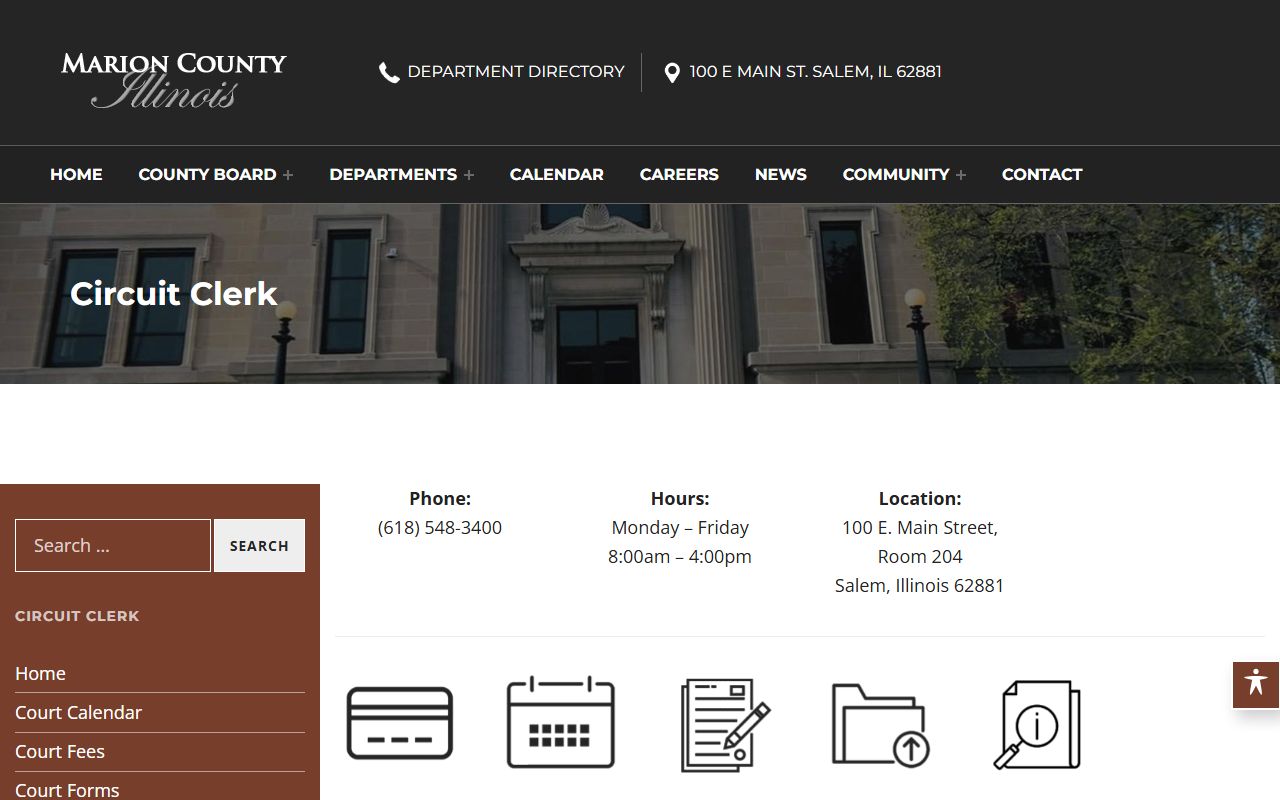
From that page a reader can reach the online case search and the records-request form that turn an arrest into a set of court records.
How to Find Marion County Court Records After an Arrest
The online route runs through Judici, the case-search vendor the circuit clerk and the state courts link to for Marion County. The court case search is at the Judici Marion County endpoint, and it may show a human-verification step before it loads. Search by defendant name or by case number if you have one.
The steps below move from the arrest to the filed charges on the court record.
- Open the Judici Marion County case search and clear any verification prompt.
- Search by the defendant's name, or enter the case number if it is known.
- Open the case and read the charge list, the filing dates, and the case type code.
- Check each charge's level and current status, and note that booking charges can differ from filed charges.
If a case does not appear online, call or visit the Marion County Circuit Clerk at 100 E. Main St., Room 204, Salem. The clerk page lists (618) 548-3400, while the state courts directory lists (618) 548-3856, so use the number tied to your task. Records can also be searched free in the office, and the clerk can run a non-automated search for a fee when case details are unknown. Court records are organized by case-type codes such as CF for a criminal felony, CM for a criminal misdemeanor, DT for driving under the influence, and DV for domestic violence.
How Charges Get Filed After an Arrest: Complaint, Information, and Indictment
The court record starts when the prosecutor files a charging document. Booking happens first at the jail, and then one of three documents opens the formal case. The type used depends on how serious the charge is and how the prosecutor proceeds.
| Complaint | Information | Indictment | |
|---|---|---|---|
| Filed By | Officer or prosecutor | Prosecutor | Grand jury |
| Common For | Early or misdemeanor charges | Many felonies | Serious felonies |
| Starts | The case | The case | The case |
The jail roster charge is a booking label, useful for the custody stage but not the final legal charge. The court charge in the clerk's record is the authoritative one. A complaint can be replaced later by an information or an indictment as the case develops.
Charge Status After a Marion County Arrest
Charges shift as a case moves through court. A charge can be amended, reduced, added, dropped, or dismissed, and the booking charge on the jail roster can differ from what the prosecutor finally files. The terms below show up on the court record and signal where a charge stands.
| Status | What It Means |
|---|---|
| Pending | The charge is filed and the case is still open. |
| Amended / Reduced | The prosecutor changed the charge, often to a lesser offense. |
| Dismissed | The charge ended without a conviction. |
| Nolle Prosequi | The prosecutor chose not to pursue the charge, ending it. |
Note: Court dates for a Marion County case can be viewed online through Judici, but warrant details are not given out over the phone.
The State's Attorney's Role After an Arrest
Illinois counties use a State's Attorney rather than a district attorney. The Marion County State's Attorney is Tim Hudspeth, with an office at 100 E. Main Street, Room 107, Salem, and a phone line at (618) 548-3860. After police make an arrest and the jail books the person, this office decides what to charge.
That decision shapes the court record. The State's Attorney can file different charges than the booking charges, amend them, decline to charge, seek detention, or resolve a case by plea. Under Illinois law, a person arrested for a detention-eligible offense is brought before a judge and a charge is filed, and the state can ask the court to hold a person through a verified petition. The charges that survive this review are the ones that appear on the court record.
Bond and Release After a Marion County Arrest
Illinois changed how release works after an arrest. The Pretrial Fairness Act ended cash bail on September 18, 2023, after the state supreme court upheld the law. New monetary bail is no longer the normal way out of custody. Instead, a judge sets release conditions at a first appearance, or the state asks for detention through a hearing. Older cases with money already posted follow separate rules, and the circuit clerk's bond-refund process still applies to those.
| Path | How It Works |
|---|---|
| Release on conditions | The judge sets terms and the person is released pending trial. |
| Detention after hearing | The state petitions to hold the person; a judge decides. |
| Hold or detainer | Another warrant, agency, or federal matter can keep a person in custody. |
| Older cash bond | Money posted before reform follows prior rules; the clerk handles refunds. |
For people posting on an older bond, the clerk keeps 10 percent of the amount as bond costs and mails any refund to the address on the bail bond form once the case closes.
Warrants That Lead to an Arrest
An outstanding warrant is a common reason a person ends up booked into the Marion County Jail. No public sheriff warrant-search page was found in official sources. The clearest local guidance comes from the circuit clerk: warrant information is not given out over the phone, and failure-to-pay or failure-to-appear warrant details are available in person in Room 204 at the courthouse.
To address a warrant, the clerk cannot give legal advice, but a person may file a motion in the case file and ask for a court date. Eligible defendants can seek help from the Public Defender's office at 200 E. Schwarz St., reachable at (618) 548-5350. Once a warrant is served and the person is booked, they may then appear on the jail roster covered in the jail inmate records page.
Charges vs. Convictions
An arrest and a charge are not the same as a conviction. A charge is an accusation that opens the case, while a conviction is the outcome after a plea or a verdict. Both can appear in public court records, but they mean very different things.
| Charge | Conviction | |
|---|---|---|
| Stage | Accusation | Verdict or plea |
| Burden of Proof | Probable cause | Beyond a reasonable doubt |
| Public Record | Yes | Yes |
Reading a court record without this distinction can mislead. A dismissed or pending charge is not proof of guilt, and the case status terms above show which charges ended without a conviction.
Sealed vs. Expunged Arrest Records
Illinois lets people clear some records through sealing or expungement after a dismissal or an eligible outcome. The two are not the same, and which one fits depends on the charge and the result. Both are court processes handled through the circuit court.
| Sealed | Expunged | |
|---|---|---|
| Visibility | Hidden from most public view | Destroyed or treated as if it never existed |
| Law Enforcement | Limited access remains | Very limited access |
| Eligibility | Depends on the charge and disposition under Illinois law | Often for dismissals, acquittals, or no-charge arrests |
Clearing a record through the court is also the proper route for removing a booking photo, which the jail roster mugshots page covers in more detail.
Restricted Court Records After an Arrest in Marion County
Not every court record is open. Juvenile cases, sealed charges, and some dismissed matters are withheld from public view, and records tied to an ongoing investigation can be held back. E-filing is available in most criminal files but not in traffic tickets or ordinance violations. When a record is restricted, the clerk's office can confirm whether a case exists even if the documents are not public.
Important: Court records here come from a private reference, not an FCRA-regulated consumer reporting agency, so they may not be used for employment, housing, credit, or other FCRA-covered screening.